
Bitcoin at $70,000? Why One Bounce May Fool You
Table of contents
You buy because Bitcoin looks cheaper. It gets cheaper again. Then one green candle appears, and suddenly the bottom feels obvious.
But a falling market can bounce before falling further.
The areas in focus are roughly $73,150 and the $70,000 region below it, based on IG’s November 9 analysis.
The question is whether buyers can hold the price up, not just how far it has fallen. ✅
Why did Bitcoin’s rebound run out of steam?
IG points to technology-stock weakness, ETF withdrawals and the closing of leveraged positions. Several sources of selling pressure arrived together.
A brief price rise doesn’t necessarily mean those pressures have disappeared. For a bounce to last, buyers need to do more than produce one strong candle.
Which prices matter?
Here are rounded areas from that analysis. They’re a map of possible pressure points, not a set of buy orders.
| Area | Why it matters |
|---|---|
| Around $73,150 | The 200-day average at the time. IG warned about two daily closes below it |
| Around $70,000–$70,480 | The next potential support area if that level gave way |
| Around $75,000–$76,230 | An area the analysis said a recovery would need to reclaim |
A daily close is the price at the end of a day’s candle. A 200-day average smooths prices across 200 days.
Briefly dipping below an area differs from repeatedly failing to hold it. And reaching $70,000 wouldn’t make a rebound automatic. A widely watched number can still fail to attract enough buying.
Why care about ETF withdrawals?
An ETF is a fund that trades on an exchange. Spot Bitcoin ETFs give investors a route into Bitcoin exposure without holding coins directly.
Money leaving those funds can weaken one source of buying demand.
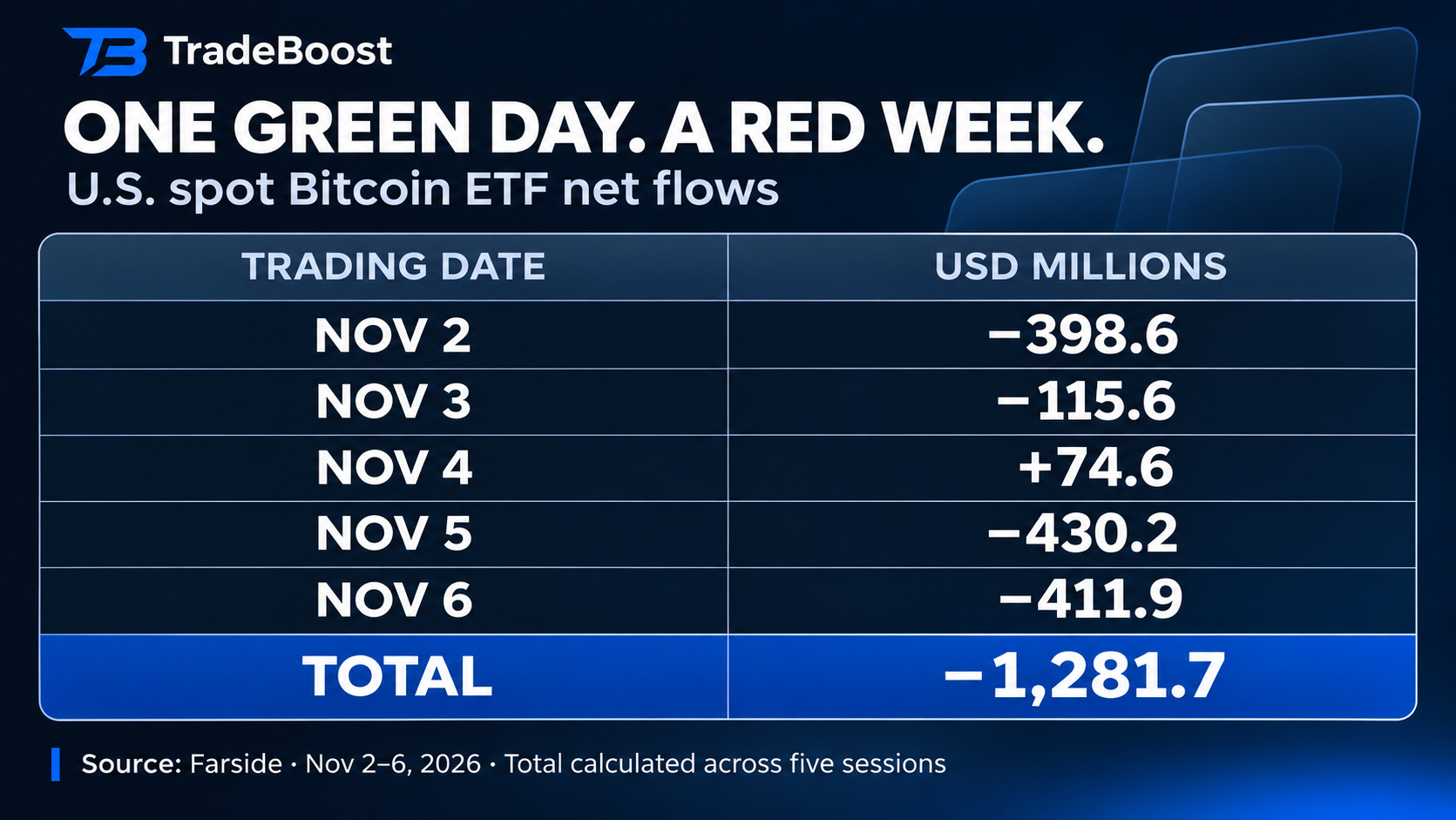
Farside’s figures show this pattern across November 2–6. The unit is millions of U.S. dollars; negative values mean net withdrawals.
| Trading date | Net flow, USD millions |
|---|---|
| November 2 | −398.6 |
| November 3 | −115.6 |
| November 4 | +74.6 |
| November 5 | −430.2 |
| November 6 | −411.9 |
| Five-session total | −1,281.7 |
That’s about $1.28 billion in net outflows, calculated by adding the five sessions. One day brought money in. The week still saw much more leave.
Think of a bathtub. Adding a bucket doesn’t raise the water level for long if more water is escaping through the drain.
This table describes those five dates. It doesn’t establish today’s live flow.
Is this a reason to buy or wait?
It isn’t enough evidence to declare a bottom. “It’s cheaper” is a weaker argument than a visible improvement in demand.
A more convincing bounce would involve:
- A price that holds: the rebound doesn’t immediately give way to another lower low.
- Buying that continues: ETF inflows last beyond a single positive session.
- Resilience to news: the market holds up after the initial reaction, rather than reversing straight away.
Those developments wouldn’t guarantee a profit. They would give you something more concrete to assess than the size of the drop.
What if you already bought higher?
Buying more lowers your average entry price. It doesn’t improve the market by itself. It also leaves more of your money exposed if the price keeps falling.
That’s why your break-even price and Bitcoin’s likely direction need separate consideration.
A bounce can be an opportunity. It still needs evidence before you call it a bottom.
That’s the useful question to send a friend celebrating the first green candle.
If you’re already trading, check TradeBoost’s fee-payback terms.
Price areas come from IG’s November 9 analysis; ETF flows cover November 2–6. These aren’t live quotes or trading instructions. Trading can cause losses.
What TradeBoost is
TradeBoost is a third-party affiliate-rebate service that returns a portion of exchange affiliate commissions to users as USDT on Arbitrum One. TradeBoost is not an exchange, broker, custodian, or investment service, and does not provide trading, custody, or financial advice.
General disclaimer
This article is for informational purposes only. All trading occurs on third-party exchanges under their terms. Trading and investment decisions should be made based on your own judgment and risk tolerance.
Related articles
 market-updates
StreetTV’s Bitcoin Warning: Why He Isn’t Buying the Dip
Why did StreetTV cancel his Bitcoin buy? Read the story, his wait-on-new-buys stance, the chart area he worries about, and why Nasdaq weakness matters.
 market-updates
Bitcoin YouTubers Changed Their Minds. Should You Sell?
StreetTV cancelled a buy. CryptoFonk invalidated a view below the 120-day average. What do those changes mean if you already own Bitcoin?
 market-updates
Lower CPI, Higher Bitcoin? The Trap Before Today’s Release
Why can Bitcoin fall even when inflation cools? Before today’s CPI release, understand expectations, interest rates and the first price reaction.