
Crypto Funding Fees: Calculate What You Pay or Receive
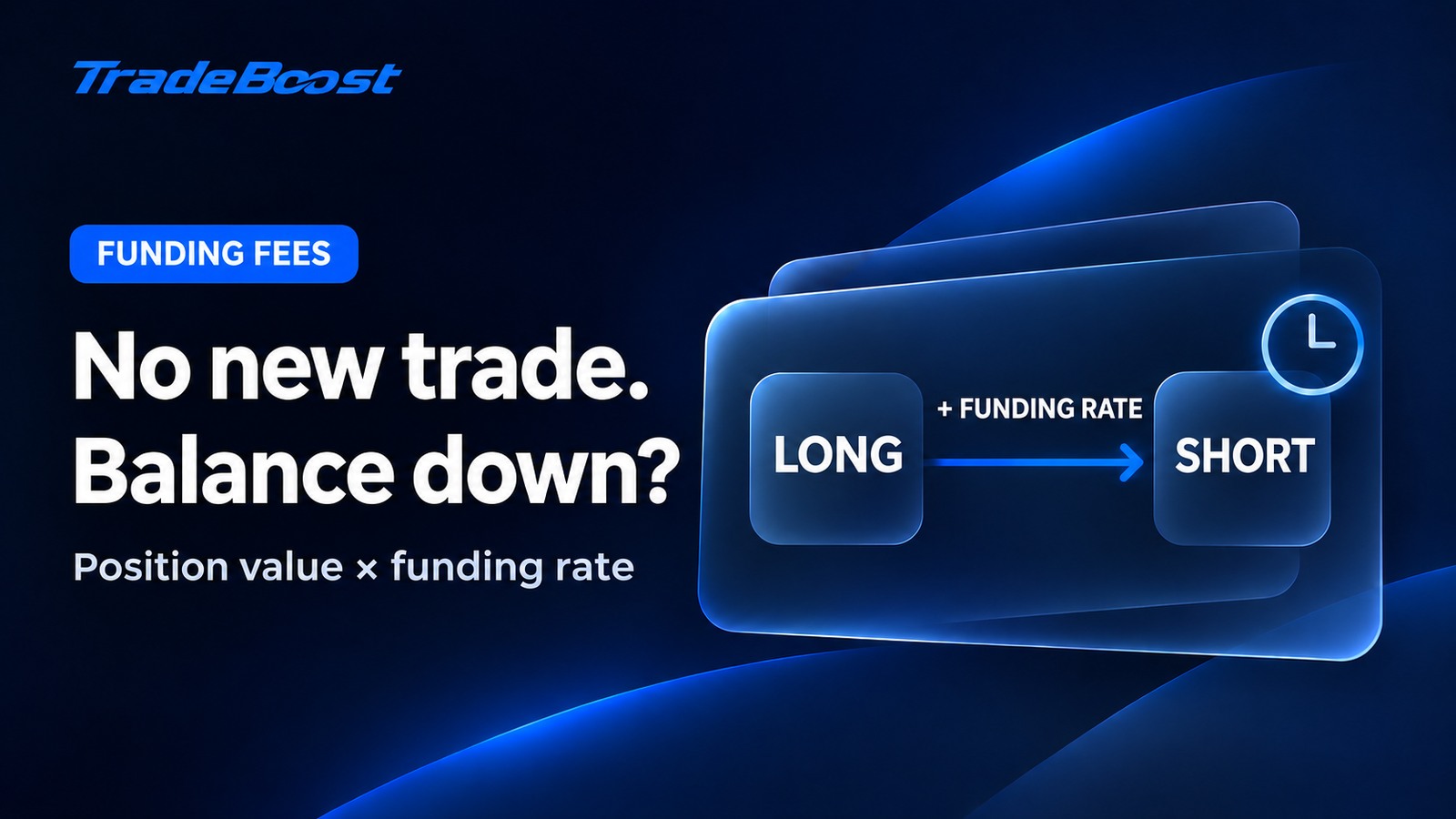
Table of contents
Why did your futures balance drop when you haven't placed another trade? Before blaming the trading fee, check whether a funding payment settled while you held the position.
Funding is based on the position you hold at settlement, not on placing a new order. You can pay it or receive it.
Checked November 10, 2026, against Bybit's funding guide and Binance's funding explanation. The rates and position sizes below are illustrations, not current market data.
The quick answer ✅ Funding fee = position value × funding rate. For a USDT-margined perpetual, use the position value at settlement. Don't substitute your margin balance for that value.
What are you paying for if you didn't trade? ✍️
A perpetual contract is a derivative with no fixed expiration date. Funding helps keep its price connected to the underlying spot market.
The payment moves between traders holding opposite positions. Long means exposure that benefits from a rising price. Short means exposure that benefits from a falling price.
You can think of funding as a recurring holding adjustment. It differs from a checkout fee because money can flow in either direction.
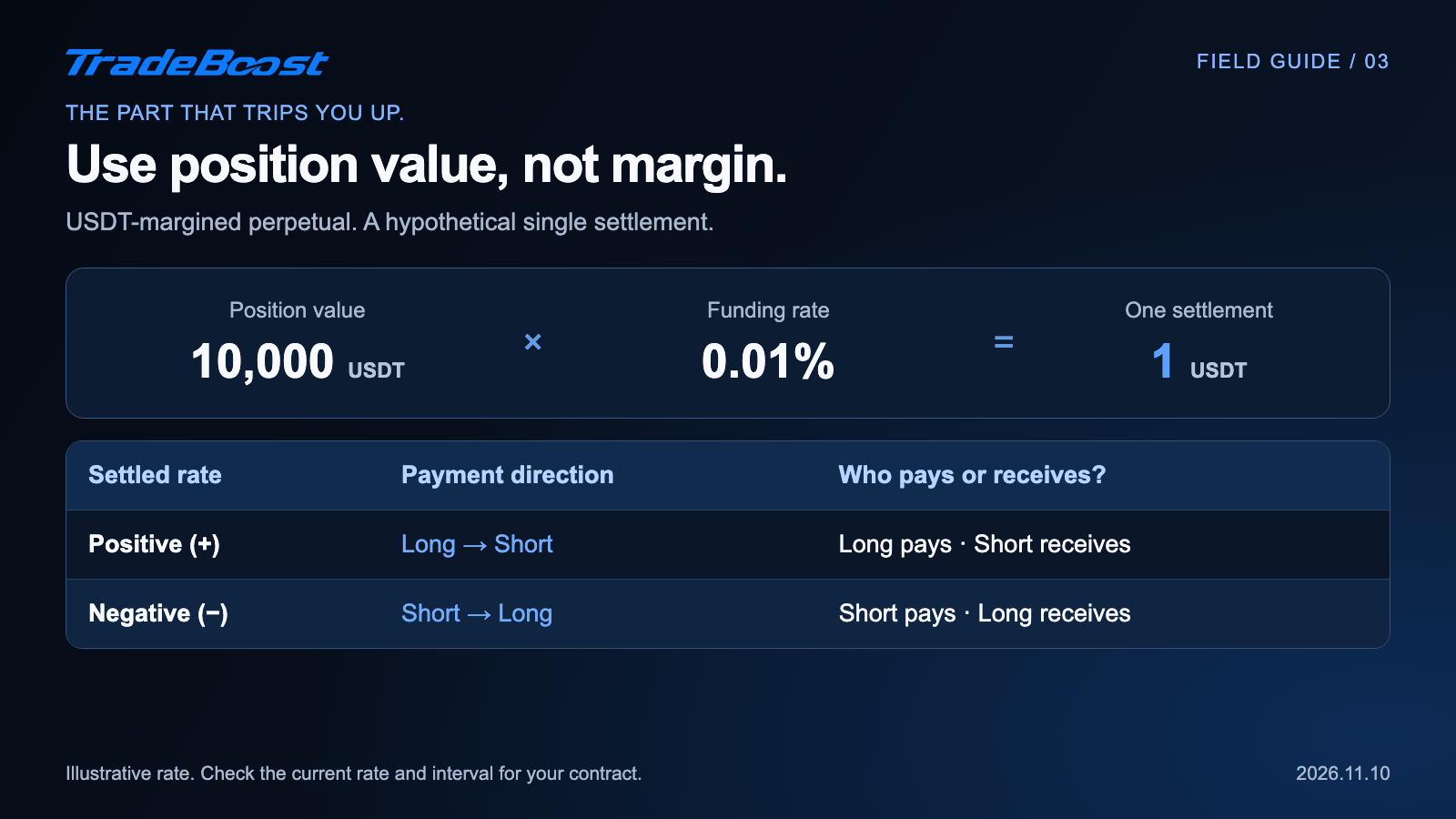
When the funding rate is positive, longs pay shorts. When it's negative, shorts pay longs. A zero rate produces a zero funding amount.
That doesn't make receiving funding a free return. A move against your position can cost much more than the payment you receive.
How do you calculate a USDT funding payment? 📊
For this example, we're using a linear USDT-margined perpetual. USDT is a stablecoin designed to track the US dollar. Other contract types can use different valuation and settlement units.
First find the position value. For the linear contract in this example, it's the contract quantity multiplied by the mark price, the exchange's reference price for valuation.
Then multiply that value by the funding rate used at settlement:
Position value = quantity × mark price
Funding fee = position value × funding rate
Assume your position value is 10,000 USDT and the settled rate is +0.01%. Convert the percentage to a decimal before multiplying.
| Input | Illustrative value |
|---|---|
| Position value at settlement | 10,000 USDT |
| Funding rate | +0.01% |
| Rate as a decimal | 0.0001 |
| One settlement amount | 10,000 × 0.0001 = 1 USDT |
A long with that value pays 1 USDT. A short of the same value receives 1 USDT. At -0.01%, the direction reverses.
The amount is for one settlement. It isn't automatically a daily cost, an annual rate or the total for the life of the trade.
Why can't you multiply the rate by your margin instead?
Margin is the collateral supporting the position. Notional value is the size of the position itself. They're different numbers.
Suppose you use 1,000 USDT of margin for a 10,000 USDT position. With the hypothetical +0.01% funding rate, the calculation still starts with 10,000, not 1,000.
Using the margin alone would give you 0.10 USDT. The correct amount in this scenario is 1 USDT, ten times that estimate.
Don't multiply by leverage again after you've used the full position value. You'd be counting its effect twice.
This is why a small-looking rate can matter relative to your collateral. The percentage applies to the larger exposure. Increasing leverage doesn't turn funding into a smaller percentage of your own funds.
For an inverse or coin-margined contract, check the contract's own formula and settlement asset. Don't paste the linear USDT calculation into a different product and assume the units still work.
Is funding always charged every eight hours? 🔎
No. Look up the current interval for the specific contract.
For an eight-hour schedule, an example set of settlement times is 00:00, 08:00 and 16:00 UTC. That example doesn't establish the schedule for every pair.
Bybit's guide says intervals can differ by pair and can change. Binance also describes interval adjustments, so a saved screenshot isn't a permanent timetable.
Read the rate together with its interval and the next settlement time. Comparing two percentage figures without their intervals can give you the wrong cost comparison.
Also check the timezone. A countdown, a UTC timestamp and your local transaction history may be showing the same event in different ways.
Can you rely on closing a few seconds before settlement?
Don't build your cost estimate around a last-second timing trick. Settlement processing can take time, and an order you intended to close may not finish when you expected.
Bybit specifically warns that position changes within five seconds of the funding time don't guarantee inclusion or exclusion. Use the settlement explanation and your actual record rather than assuming a precise cutoff from your device clock.
The practical job is to know your exposure and the expected cost before that point. It's not to turn the final seconds into another source of execution risk.
An estimated rate on the trading screen also isn't necessarily the final booked payment. Reconcile against the settled amount in your history.
Does a trading-fee discount reduce funding too?
Don't treat the two as the same expense. A trading fee is tied to execution. Funding is tied to holding a position at settlement.
| Cost | What triggers it? | Where should you check? |
|---|---|---|
| Trading fee | An order fills | Fill history and applicable fee rate |
| Funding payment | A position is held at settlement | Funding history or transaction log |
A referral discount or cashback on eligible trading fees doesn't, by itself, establish a discount on funding. Don't apply that percentage to the 1 USDT example unless the specific terms actually cover it.
Keep credited benefits as a separate line in your worksheet. Otherwise, a commission rebate can hide the holding cost you're trying to measure.
How do you check what actually happened? 🎯
Start with a single settled entry. Record the contract, position direction, position value, rate, timestamp and whether money went out or came in.
Then calculate the expected amount and compare it with the transaction record. If the numbers don't match, check units and settlement price before assuming the rate was wrong.
For a longer review, add the actual settlements over your chosen period. Don't multiply one calm-market rate by a year. Position sizes, rates and intervals can change.
Separate paid funding from received funding, then calculate the net result. Keep trading commissions and price gains or losses in their own columns. That gives you an explanation you can actually use.
The useful takeaway is simple: a flat-looking trade can still carry a holding cost. Check the full position value and the settlement record before deciding how expensive it was.
For the execution side, read how to calculate your crypto trading fees. You can check trading-fee benefits separately on TradeBoost.
This article is for informational purposes only, not financial advice. All numerical examples are hypothetical. Funding rates and intervals change, and derivatives involve loss and liquidation risk. TradeBoost may receive compensation for partner referrals.
What TradeBoost is
TradeBoost is a third-party affiliate-rebate service that returns a portion of exchange affiliate commissions to users as USDT on Arbitrum One. TradeBoost is not an exchange, broker, custodian, or investment service, and does not provide trading, custody, or financial advice.
General disclaimer
This article is for informational purposes only. All trading occurs on third-party exchanges under their terms. Trading and investment decisions should be made based on your own judgment and risk tolerance.
Related articles
 exchange-guides
Crypto Trading Fees: Calculate What You Actually Pay
Calculate crypto trading fees from actual fills. Avoid double-counting entries, exits and leverage, and separate funding costs from received credits.
 market-updates
Bitcoin Near $65,000: Buy the Dip or Wait?
Bitcoin traded near $65,000 after a selloff. Here's what the next price retest and U.S. spot Bitcoin ETF flows could tell you about buying the dip.
 market-updates
Nvidia Earnings: Could Bitcoin Move After the Report?
See when Nvidia reports and when Fed minutes are released, plus what Bitcoin, Nasdaq futures and Treasury yields can tell you afterward.