
Why Your Limit Order Paid Taker Fees: Post-Only Explained
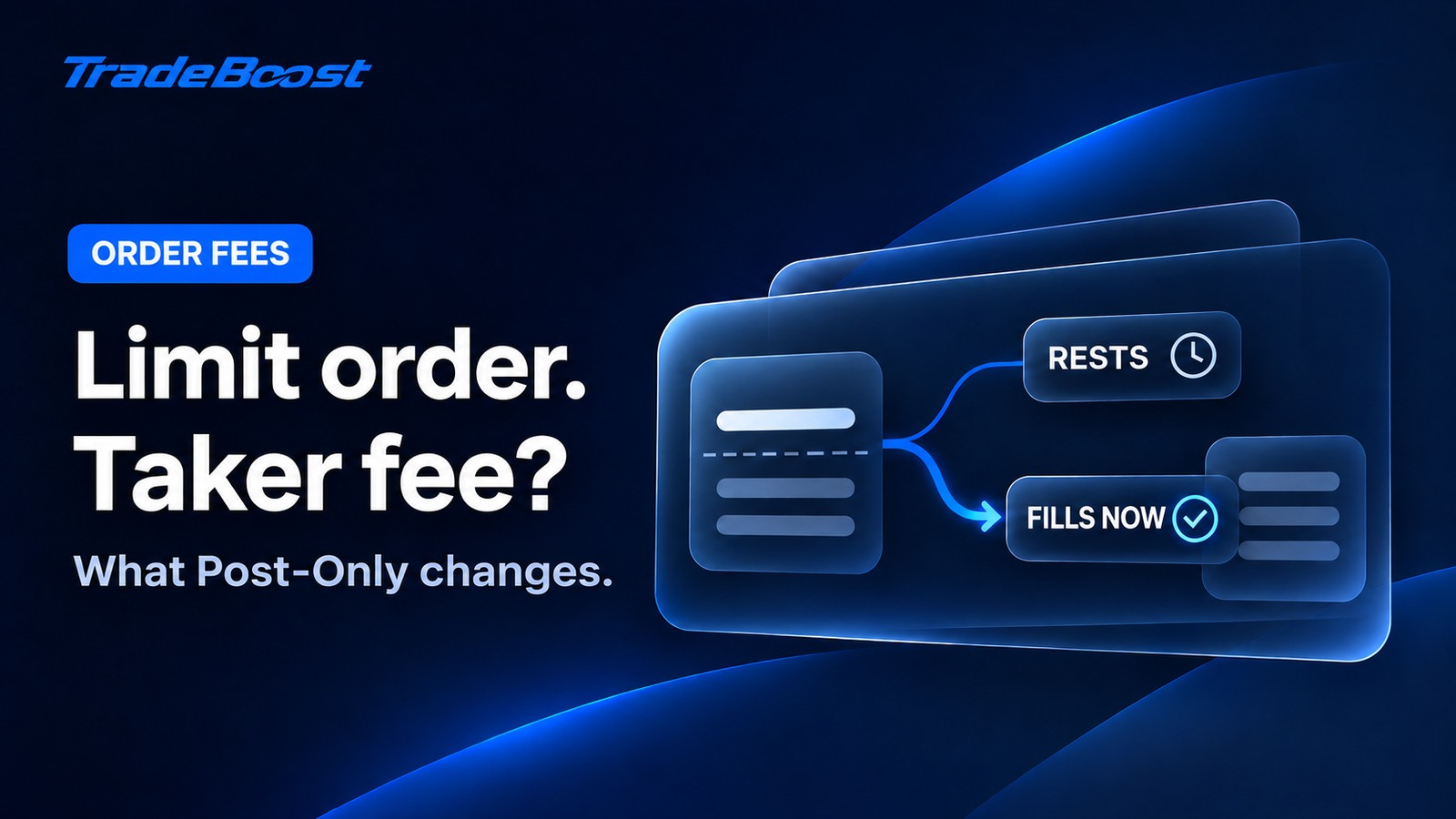
Table of contents
You chose a limit order on Bybit, so why does the fill show a taker fee? Did the exchange ignore your order type?
Probably not. A limit price controls the price you're willing to accept. It doesn't automatically make you a maker. Your role depends on how the order actually meets the order book.
Checked November 10, 2026, against Bybit's maker and taker explanation and Bitget's Spot Trading Terms. All prices and fee rates below are teaching assumptions, not live quotes or account-specific rates.
The quick answer ✅ A limit order that fills immediately against an existing order can pay taker fees. Post-Only prevents that immediate execution, but your order may be canceled instead.
Why doesn't a limit order guarantee a maker fee? ✍️
The order book is the list of waiting buy and sell orders. A maker adds an order that rests there. A taker trades against something already waiting.
Think of a neighborhood buy-and-sell board. You can post your own offer and wait, or accept an offer that's already pinned up. Both involve a price. Only one adds a new offer to the board.
Now assume the lowest available sell price, called the best ask, is 100 USDT. USDT is a stablecoin designed to track the US dollar.
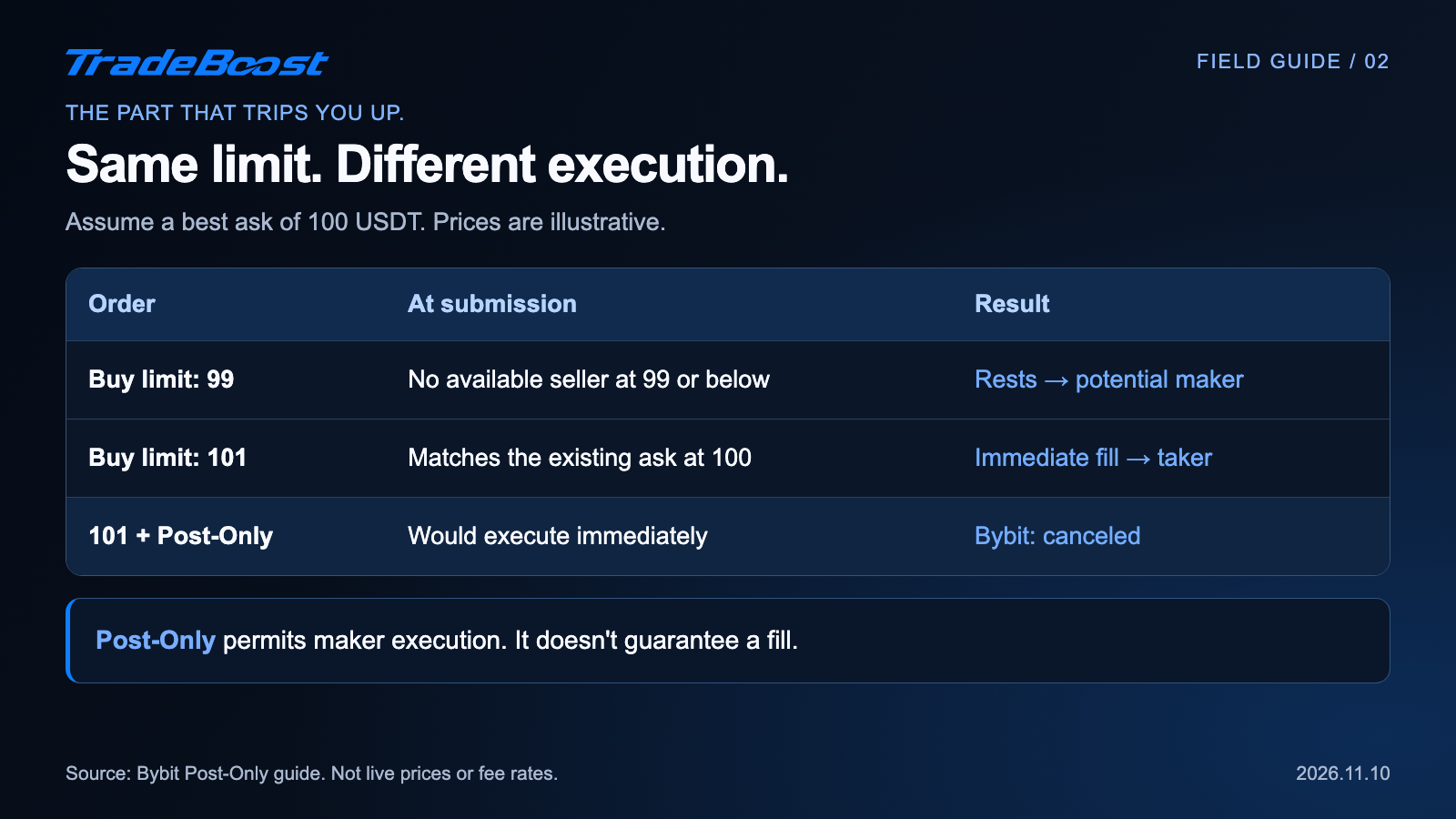
You submit a buy limit at 101. That means you're willing to pay up to 101, not that you must pay exactly 101. The existing sell order at 100 fits your limit.
If the order fills against that seller immediately, you've taken liquidity. That's why "limit" on the order ticket and "taker" on the fill can both be correct.
| Your buy order | Situation at submission | What can happen? |
|---|---|---|
| Limit at 99 | No seller available at 99 or below | It can rest, becoming a potential maker fill |
| Limit at 101 | An existing seller is offering 100 | The immediately matched portion is a taker fill |
| Limit at 101 with Post-Only | It would immediately match 100 | Bybit cancels it instead |
These are simplified examples. They assume a resting limit order is allowed and don't model a changing book or other order conditions.
What does Post-Only actually change? 🔎
Post-Only adds an execution condition: the order must join the book rather than immediately trade against an existing order. Bybit says it cancels an order that would execute immediately. See its Post-Only guide.
So a canceled Post-Only order isn't necessarily a broken order. The condition may have worked exactly as intended.
That matters when prices move while you're submitting. A price that looked safe to post a moment ago may cross the best opposite quote by the time the order arrives.
Check the cancellation reason before repeatedly placing it again. If it would still cross, repeating the same price doesn't solve the problem.
An accepted order also isn't a guaranteed fill. It can wait while the market moves away. Post-Only controls the role you permit, not whether another trader will take your order.
How much difference can the role make? 📊
Let's use a 10,000 USDT fill and two hypothetical fee rates: 0.02% maker and 0.05% taker. These aren't a quote for Bybit or any other exchange.
| Assumed role | Calculation | Fee for this fill |
|---|---|---|
| Maker | 10,000 × 0.0002 | 2 USDT |
| Taker | 10,000 × 0.0005 | 5 USDT |
That's a 3 USDT difference on one fill. If both entry and exit have the same 10,000 USDT value and role, the total is 4 or 10 USDT.
Real entry and exit values can differ. Calculate them separately instead of doubling a single fee by habit.
The bigger decision is whether waiting suits the trade you're trying to execute. Saving a small commission doesn't help if a delayed or unfilled order creates a larger problem.
Post-Only isn't a loss limit. It doesn't guarantee a favorable market price, protect an existing position or replace a risk-management plan.
Can one order include both maker and taker fills?
Yes, depending on the order conditions and exchange. An order can match available liquidity immediately, then leave an unfilled remainder resting on the book.
Bitget's Spot Trading Terms describe the taker phase and how an eligible remaining GTC limit order becomes a maker order. GTC means "good till canceled."
For your own records, the useful unit is the individual fill. The original order type alone won't explain every fee line.
Suppose your order breaks into several executions. Record the filled value, assigned role, applied rate and fee for each one. Then add the actual charges.
Don't apply one role to the entire original order just because its first fill used that role. Also don't calculate a fee on the unfilled portion as if it already traded.
Where should you look if the fee seems wrong?
Open the execution or trade-history record for the order. The exact menu varies by product, but you're looking for fills rather than just an open-order summary.
Check these fields together:
- Product and pair. Spot and perpetual contracts can use different schedules.
- Execution role. Was this particular fill marked maker or taker?
- Filled value and rate. Use the account's applicable fee tier and benefit settings.
- Fee currency. Keep the original asset and amount before converting it for comparison.
If the export already includes both your entry and exit, don't double that volume again. If a fee was charged in another asset, a later conversion price can also distort your comparison.
Keep a screenshot or export of the actual fill if you need support. A screenshot showing only the Limit button doesn't establish which role the final execution received.
What should you remember before the next order? 🎯
Keep this distinction handy: price condition, execution role, actual fee. They're connected, but they aren't interchangeable.
Use Post-Only when you specifically want to avoid an immediate taker execution and can accept the possibility of cancellation or no fill. Check the current product's behavior before relying on it.
If a friend keeps asking why a limit order paid taker fees, send them the table. It explains the surprise without making them memorize a fee schedule.
For a broader cost worksheet, read how to calculate your crypto trading fees. You can review account-specific trading-fee benefits separately on TradeBoost.
This article is for informational purposes only, not financial advice. All example prices and fee rates are hypothetical. Rates, order features and availability depend on the product, account and location. TradeBoost may receive compensation for partner referrals.
What TradeBoost is
TradeBoost is a third-party affiliate-rebate service that returns a portion of exchange affiliate commissions to users as USDT on Arbitrum One. TradeBoost is not an exchange, broker, custodian, or investment service, and does not provide trading, custody, or financial advice.
General disclaimer
This article is for informational purposes only. All trading occurs on third-party exchanges under their terms. Trading and investment decisions should be made based on your own judgment and risk tolerance.
Related articles
 trading-education
Why Did My Limit Order Pay a Taker Fee?
A limit order can pay taker fees when it matches immediately. See how mixed fills work, what to check in your history and when post-only helps.
 trading-fees
Binance, Bybit, OKX & Bitget Fees 2026: Rates & Discounts
Compare Binance, Bybit, OKX and Bitget Spot and Futures fee references, then check TradeBoost referral discounts, round-trip costs and cashback bases.
 exchange-guides
Binance, Bitget, OKX and Bybit Fees: How to Compare
Compare Binance, Bitget, OKX and Bybit trading costs using the right fee tier, order type, funding, and withdrawal network.