
Binance, Bybit, OKX & Bitget Fees 2026: Rates & Discounts
Table of contents
Comparing Binance, Bybit, OKX and Bitget fees? Start with published fee references, then referral discounts and cashback calculation bases. You'll see the product rates side by side before checking the TradeBoost offers that may apply to your account.
Checked November 5, 2026. The table below uses official published fee schedules and calculation references. It's a baseline before referral benefits, token-payment discounts and VIP adjustments. OKX's row is explicitly a published calculation reference; your local account schedule takes priority.
The quick answer: compare Spot with Spot and Futures with Futures. Then compare maker with maker and taker with taker. Add entry and exit separately, and keep funding outside the trading-fee line. 📊
What are the four exchanges' published fee rates?
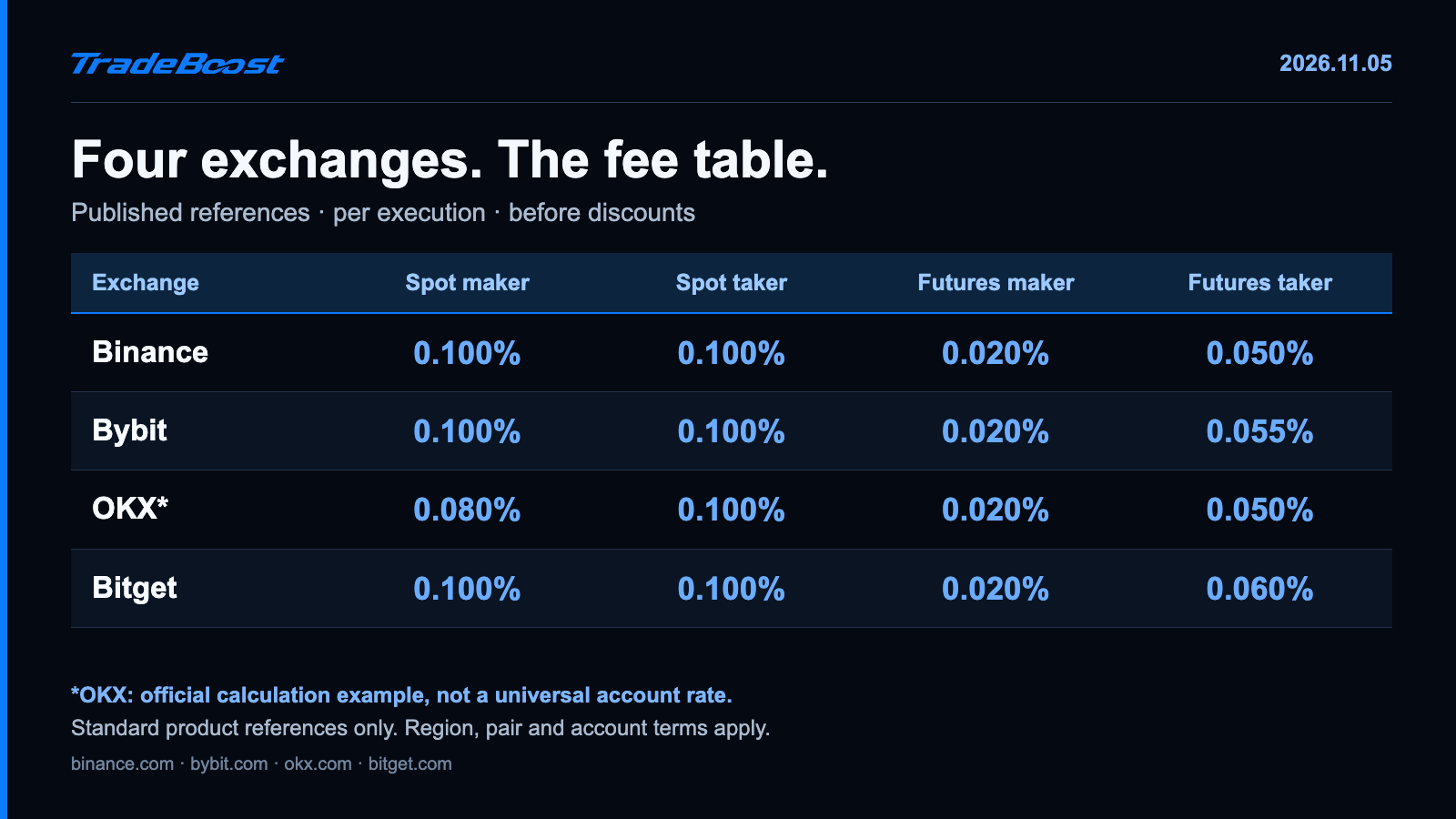
These figures are percentages per execution. The Spot columns refer to ordinary crypto order-book pairs. The Futures columns use standard USDT-margined contract references. They aren't a quote for every region or product.
| Exchange | Spot maker | Spot taker | Futures maker | Futures taker | Source basis |
|---|---|---|---|---|---|
| Binance | 0.100% | 0.100% | 0.020% | 0.050% | Regular-user standard schedules |
| Bybit | 0.100% | 0.100% | 0.020% | 0.055% | VIP 0 ordinary crypto Spot and standard contracts |
| OKX* | 0.080% | 0.100% | 0.020% | 0.050% | Rates used in the official fee-calculation examples |
| Bitget | 0.100% | 0.100% | 0.020% | 0.060% | Published standard rates |
Scope: checked November 5, 2026; no referral, token-payment or VIP reductions included. The OKX row is an official worked-example reference, not confirmation of a universal current tier. Check your local fee page and logged-in pair. Regional schedules, special trading zones, USDC pairs and promotions can differ.
The numbers come from Binance Spot and USDⓈ-M Futures, Bybit's fee structure, OKX's fee rules and Bitget's fee breakdown.
Keep the table and its scope note together if you share it. A screenshot without the date or product can turn a useful comparison into a misleading quote.
What do maker and taker actually mean?
A maker leaves an order waiting on the order book. A taker matches an order that's already there. Think of a maker as putting an item on a shelf and a taker as picking one up immediately.
The key is execution, not the button's name. A limit order can still pay taker fees if it crosses the book and fills immediately. A partially filled order can also have different fee treatment across fills.
Where available, a post-only instruction is designed to keep an order from immediately taking liquidity. But it may cancel instead of filling. A lower fee isn't useful if the execution no longer fits your plan. OKX's fee FAQ explains the execution distinction.
What would a $10,000 round trip cost?
Use the formula execution value × fee rate for each fill. Then add both sides.
Here's a deliberately simple comparison: a $10,000 Futures taker entry and a $10,000 taker exit, using the reference rates above. The notional is held constant for this illustration. No funding, discounts, spread or slippage is included.
| Exchange reference | Entry fee | Exit fee | Round-trip trading fee |
|---|---|---|---|
| Binance, 0.050% taker | $5.00 | $5.00 | $10.00 |
| Bybit, 0.055% taker | $5.50 | $5.50 | $11.00 |
| OKX example, 0.050% taker | $5.00 | $5.00 | $10.00 |
| Bitget, 0.060% taker | $6.00 | $6.00 | $12.00 |
At a 0.020% maker rate on both executions, that same constant-notional illustration would cost $4. But the trade still has to fill as a maker, and your own account must have that rate.
Futures fees usually use the full executed position value. If $1,000 of margin supports a $10,000 position, don't calculate the fee on $1,000. Leverage changes exposure; it doesn't turn a $10,000 execution into a $1,000 execution.
Which costs are missing from that table?
The maker/taker line isn't the whole bill.
- Funding: periodic payments between perpetual-contract counterparties. The rate, direction and interval depend on the contract.
- Spread: the gap between available buying and selling prices.
- Slippage: a fill price different from the price you expected.
- Withdrawal charges: the cost shown for moving assets out on a supported network.
- Borrowing interest or copy-trading profit share: separate costs if you use those products.
For a short trade, execution costs may dominate. For a position held across funding times, funding can matter more. Read the actual contract instead of assuming every perpetual settles on the same schedule. Bitget's Futures fee explainer separates trading and funding costs.
How do referral discounts change the calculation?
Apply a discount to the eligible fee, not to the trade's value. If an eligible $5 fee gets a 20% reduction, the saving is $1 and the remaining fee is $4.
Don't add percentages that use different bases. A fee discount and cashback from affiliate commission aren't interchangeable. Don't subtract a discount twice when your displayed account rate already includes it.
TradeBoost's operator-confirmed signup offers include Binance JOINTB: 20% on eligible Spot fees and 10% on eligible Futures fees, and Bitget: 20% lifetime on eligible Spot and Futures fees. Check the signup display and account terms. No fixed OKX or Bybit discount is assumed in this table.
| Exchange | TradeBoost signup route | Step-by-step guide |
|---|---|---|
| Binance | Join with JOINTB | Signup, KYC and first deposit |
| Bybit | TradeBoost partner signup | Referral, KYC and security |
| OKX | TradeBoost partner signup | Account, KYC and UID |
| Bitget | TradeBoost partner signup | Referral, KYC and deposit |
How does TradeBoost's 90% campaign fit in?
TradeBoost's 2026 new-member campaign runs through December 31, 2026. The advertised 90% rate is the distribution of eligible affiliate commission received by TradeBoost. It isn't 90% of all trading fees and shouldn't be used to multiply this baseline table directly.
Check your linked account's eligibility, confirmed rate and settled cashback. Keep an exchange fee statement and TradeBoost cashback statement as separate records so you can compare what you paid with what came back.
If you're already planning to register, choose the relevant TradeBoost signup link above and join TradeBoost to connect the account. Get the route and rate confirmed before your first trade. 🔄
What should you do with this comparison?
Pick the product you actually use. Read your logged-in maker and taker rates. Calculate one normal entry and exit at your usual order size. Add the costs your strategy actually incurs.
Then compare the full result. A small difference in a base fee is only one part of choosing a venue. Execution quality, access, account security and the ability to withdraw also matter. Don't increase volume to reach a fee tier or earn cashback.
FAQ
Is a limit order always a maker order?
No. A limit order that matches an existing order immediately can be a taker execution. Check how the order filled, not just which order type you selected.
Are opening and closing fees both charged?
Each chargeable execution can incur a fee. Calculate entry and exit separately using the value and rate for each fill.
Does the table include funding or referral discounts?
No. It separates published trading-fee references from funding, VIP adjustments, token-payment discounts and account-specific referral benefits.
Which exchange is always the cheapest?
There isn't a universal answer. Compare the same product and execution type using your own regional account rates, then include the other costs your trades incur.
Sources and last check
- Binance Spot schedule and USDT Futures schedule.
- Binance: Futures fee calculations.
- Bybit: trading fee structure.
- OKX: trading fee rules and worked examples, plus local fee schedule.
- Bitget: fee breakdown and Futures trading/funding explainer.
- TradeBoost referral offers and campaign: operator-confirmed instructions. Figures and links checked November 5, 2026.
This article contains TradeBoost affiliate links. Eligible activity may generate commission for TradeBoost. Rates are dated references, not a personalized fee quote. Account, region, product and campaign terms apply. This is educational information, not investment advice. Crypto trading can result in losses.
What TradeBoost is
TradeBoost is a third-party affiliate-rebate service that returns a portion of exchange affiliate commissions to users as USDT on Arbitrum One. TradeBoost is not an exchange, broker, custodian, or investment service, and does not provide trading, custody, or financial advice.
General disclaimer
This article is for informational purposes only. All trading occurs on third-party exchanges under their terms. Trading and investment decisions should be made based on your own judgment and risk tolerance.
Related articles
 exchange-guides
Binance, Bitget, OKX and Bybit Fees: How to Compare
Compare Binance, Bitget, OKX and Bybit trading costs using the right fee tier, order type, funding, and withdrawal network.
 trading-basics
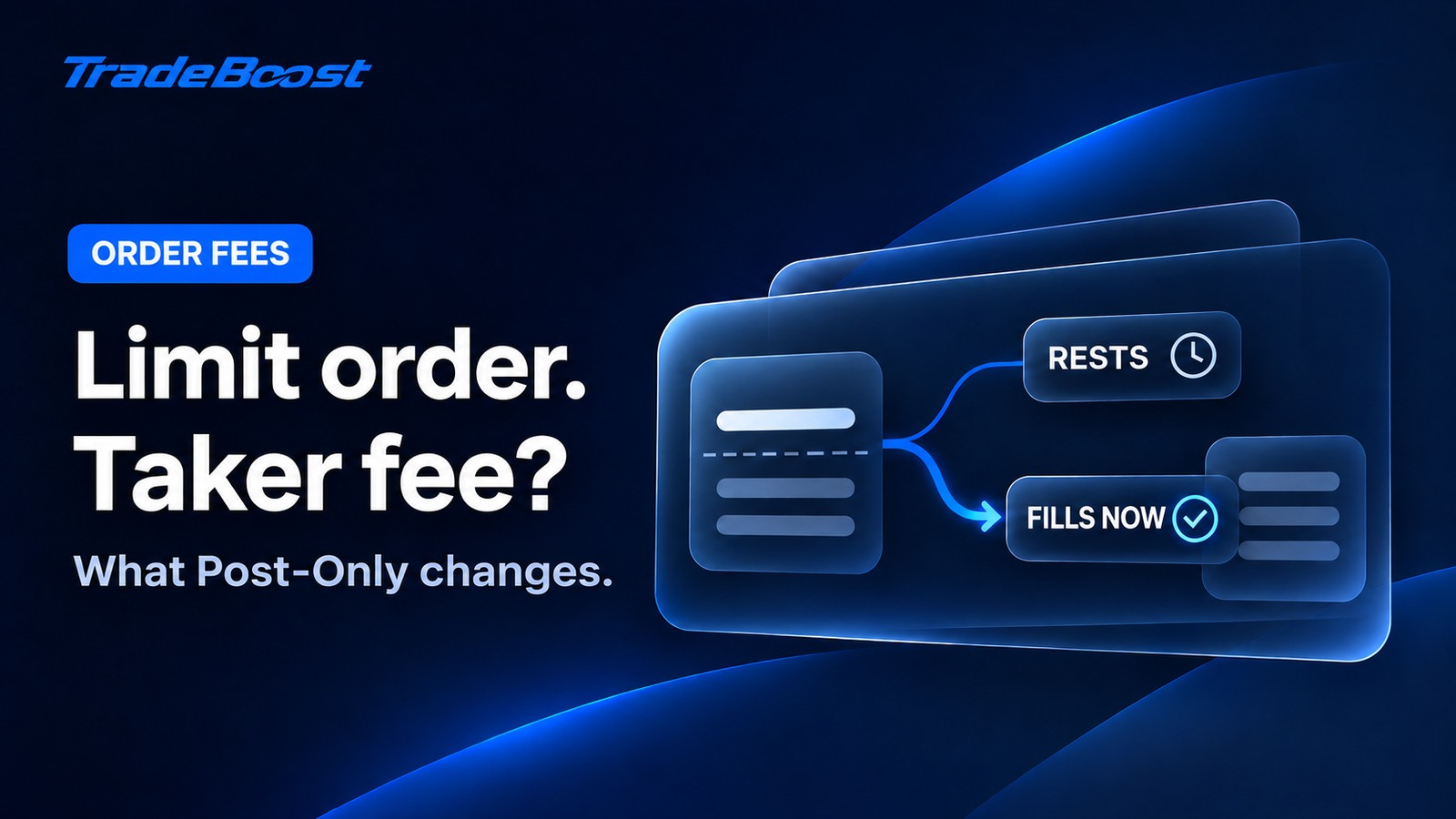
Why Your Limit Order Paid Taker Fees: Post-Only Explained
A limit order can still pay taker fees. See how Post-Only works, why orders get canceled and how to check the role and fee on each fill.
 exchange-guides
Bybit vs OKX Fees: Compare Your Actual Trading Cost
Compare Bybit and OKX fee examples using the same volume and execution mix. Learn what account rates, funding and trading costs change in practice.