
Crypto Referral Codes, Welcome Bonuses and Cashback
 TradeBoost Editorial LinkedIn 12 min read #exchange-guides #registration #kyc #referral #crypto-education
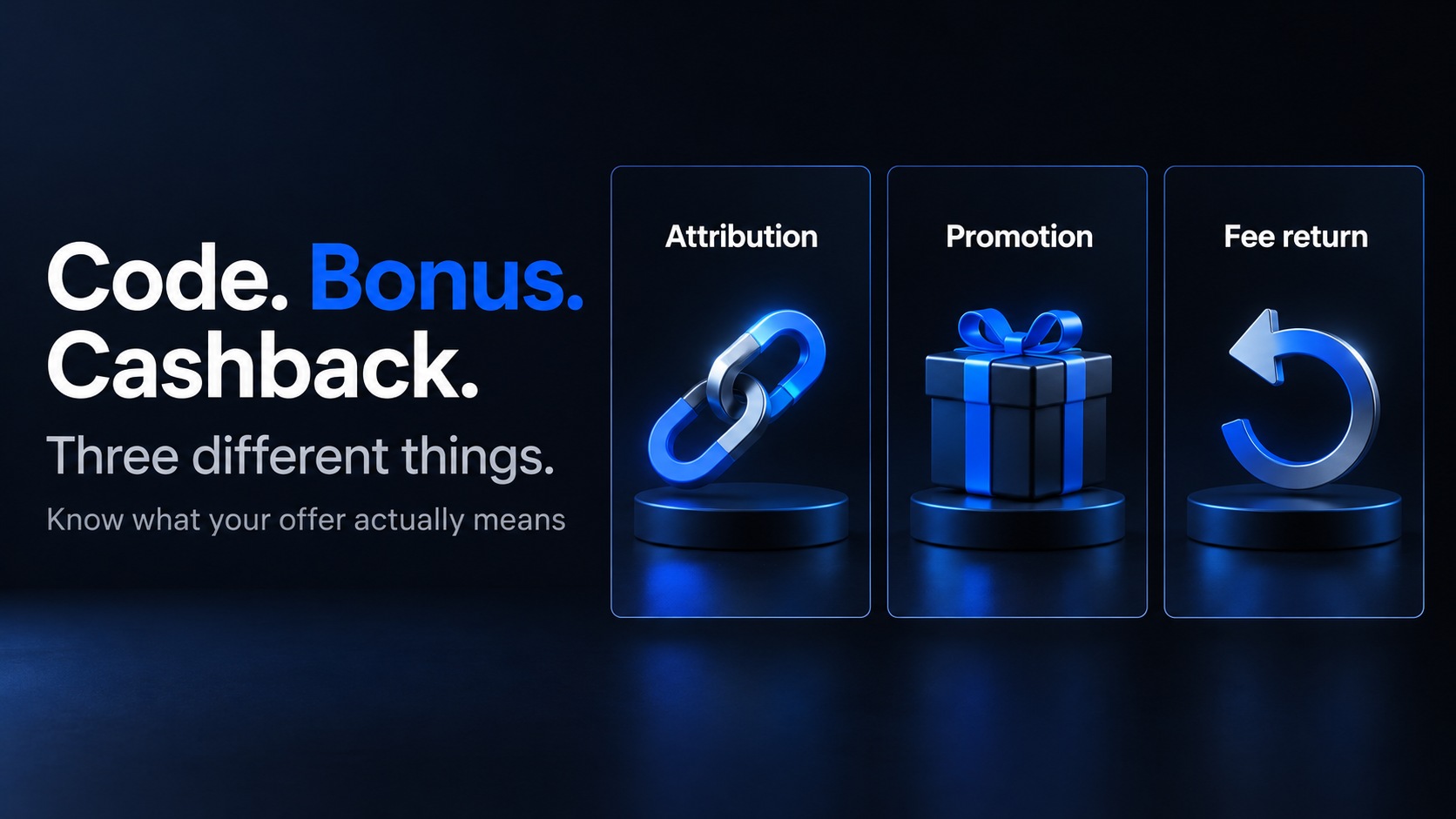
Table of contents
Does your crypto referral code give you a welcome bonus, lower trading fees, or cashback? Those are three different questions.
They're often squeezed into the same registration pitch. That makes it easy to confuse who gets paid, which activity qualifies, and what the reward can actually be used for.
Before you sign up for Bitget, Bybit, or OKX, separate the relationship from the benefit. Then compare the conditions attached to your account.
This guide gives you a way to read an offer without treating its largest number as cash you've already received. Exchange-specific references were checked October 28, 2026.
What's the simplest way to tell them apart?
The quick answer ✅
- A referral code records an invitation or attribution relationship.
- A welcome bonus is a promotion with its own qualifying tasks and terms.
- A trading-fee discount changes the fee charged under the applicable arrangement.
- Fee cashback returns part of eligible fees according to a separate program's conditions.
One account might be connected to more than one of these. That doesn't mean they automatically combine or have the same eligibility.
Think of a store loyalty program. A member number, joining coupon, price reduction, and later reward payment describe different parts of the arrangement.
You wouldn't assume a member number was itself a cash balance. Apply the same care when reading an exchange offer.
What does a crypto referral code actually do?
A referral code is an identifier used to record a relationship. Depending on the program, that relationship can connect an eligible new account with an inviter or affiliate.
The code itself doesn't tell you the benefit. You need the accompanying terms to establish whether the user, inviter, or both receive something.
For example, an invitation might qualify the inviter for a reward after specified actions. The new user may have a separate welcome offer with different tasks.
OKX's referral FAQ explicitly distinguishes the inviter's referral reward from the friend's welcome rewards. Their requirements and amounts don't have to match. OKX referral-program FAQ.
That means “this code earns a reward” is incomplete. Ask who receives the reward, what they receive, and which activity triggers it.
A referral link can carry the identifier into registration, but don't assume every click establishes the relationship. Inspect the current flow and offer terms.
If you move from a browser to an app, verify what the registration screen shows where possible. A successful app launch isn't evidence of confirmed attribution.
What is a welcome bonus?
A welcome bonus is an offer aimed at users who meet a campaign's definition of new or eligible. The campaign sets its own conditions.
Those conditions can include enrollment, identity verification, a qualifying deposit, or specified activity. Don't assume every campaign uses all these requirements.
Read the actual task list attached to the offer you're evaluating. A public maximum may combine several tasks rather than describe a single payment.
“Up to 100 units” means you need to understand how that maximum is constructed. It doesn't mean 100 units appear after account creation.
That figure is a fictional example, not an offer from Bitget, Bybit, OKX, or TradeBoost. Use it to practice reading the wording.
Also inspect what the units represent. A voucher denominated in a currency can have different use and withdrawal conditions from an unrestricted balance.
A deadline doesn't change those distinctions. You need the task definitions before you can determine whether a promotion is useful to you.
How does a trading-fee discount differ?
A fee discount reduces the applicable charge according to its terms. It can be reflected in the rate charged to eligible trading activity.
A reduction in a fee rate isn't automatically a payment you withdraw later. Check where the benefit appears and how it's calculated.
You also need to know which product it applies to. Spot trading, perpetual contracts, and other products shouldn't be treated as interchangeable fee categories.
A maker fill adds a resting order to the order book. A taker fill executes against available orders. Don't infer the fee category from the order button alone.
For your own comparison, record the actual account rate and product alongside the discount conditions. A promotional headline without the starting rate is incomplete.
Keep any separate withdrawal or payment-method charges outside that rate comparison. A lower trading rate doesn't establish a lower total cost for every user.
Our trading-fee calculation guide explains how to organize actual charges without confusing balances and trading volume.
What does trading-fee cashback mean?
A term worth knowing ✍️
Fee cashback means returning part of fees that qualify under a program. It isn't a return on your account balance or a payment for trading profit.
The arrangement needs a defined calculation basis. Ask which fees qualify, which products count, and whether excluded activity affects the total.
You also need a payment process. Check whether the amount is pending, claimable, paid, or withdrawable under the program's definitions.
A displayed estimate isn't the same as a completed payment. Keep records that separate those stages instead of treating every dashboard amount as received cash.
Programs can differ in eligibility, timing, minimums, and exclusions. Don't apply a generic cashback explanation as a promise about a specific account.
And don't assume a provider can change an exchange's existing referral attribution. Platform rules and the program's account requirements remain separate facts.
If you're already registered, clarify that status before transferring assets or making trades intended to qualify for a different arrangement.
Can you compare the four concepts in one table?
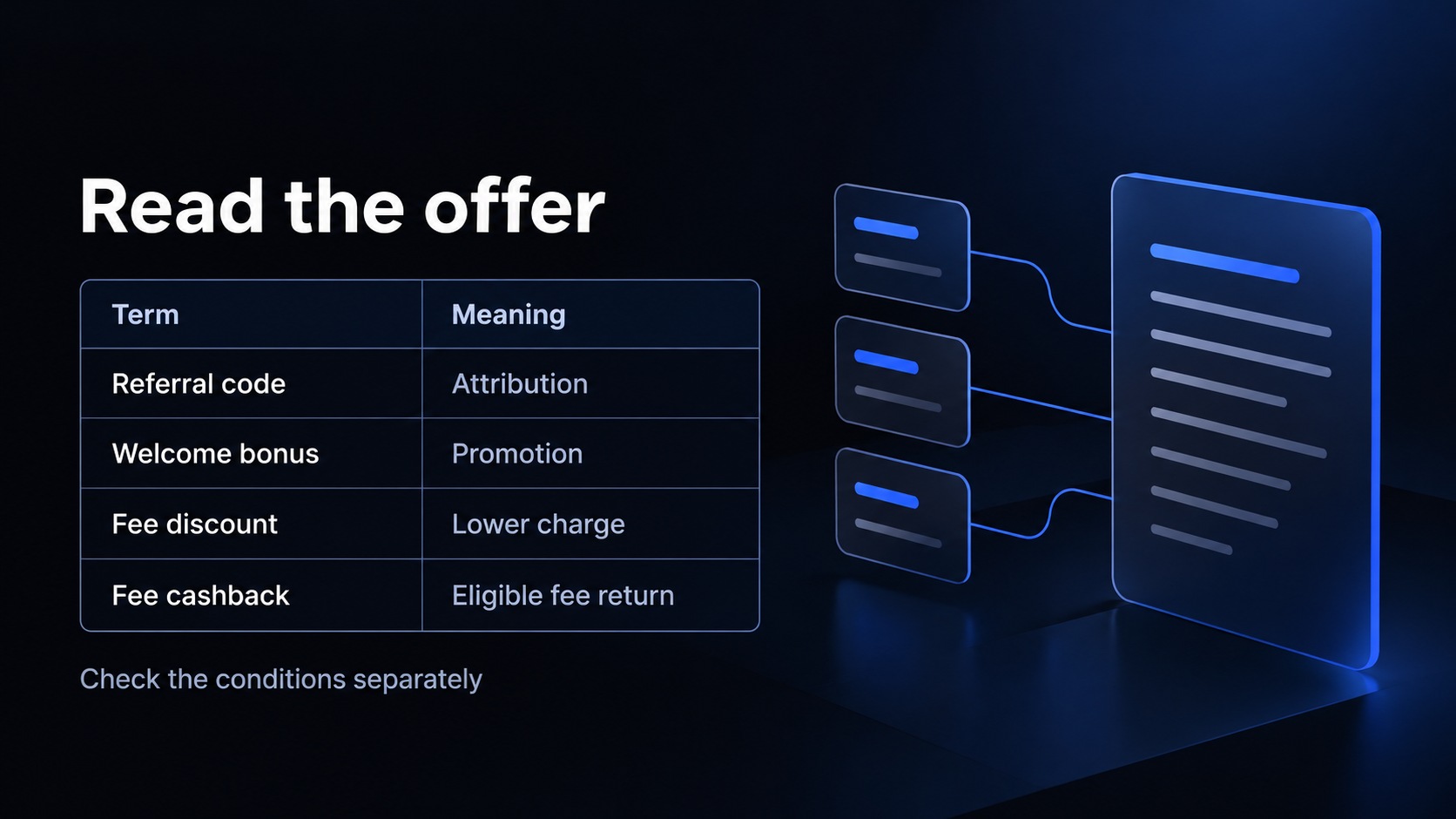
Use the table as a reading tool, rather than a promise about any current offer. Your specific terms decide what applies.
| Concept | What it describes | Evidence to request |
|---|---|---|
| Referral code | An attribution relationship | Registration and program rules |
| Welcome bonus | A promotional reward | Eligibility, tasks, reward form, expiry |
| Fee discount | A change to an applicable charge | Product-specific account rate and conditions |
| Fee cashback | A return of eligible fees | Calculation basis, status, payment and withdrawal rules |
Don't collapse the evidence into one screenshot. A registration page might show a code but say nothing about payout eligibility.
Likewise, a campaign page can describe a reward without proving your account enrolled in time. Keep the rule and the account status together.
When should you check the referral relationship?
Before you create the account, if you intend to use one. That gives you a chance to review the code and offer conditions before submission.
Bybit's account FAQ says referral codes can't be added, removed, or changed after registration. Don't assume support will substitute another code later. Bybit account FAQ.
OKX's referral FAQ says the relationship usually can't be added or changed after registration. Its exact wording matters, so check the policy for your service. OKX referral FAQ.
Bitget's mobile guide includes an optional referral field. Confirm current attribution conditions for the offer rather than borrowing another exchange's rule. Bitget registration guide.
If an account already exists, start with its current status. Another link click doesn't establish a new relationship by itself.
Don't create duplicate accounts to work around an offer's eligibility conditions. Ask the platform about your actual account and use the official process.
Which details belong in your offer checklist?
Start with the user definition. “New user” might refer to a first account, a first verified identity, or another condition specified by the program.
Then check the regional service. A reward described for one entity isn't automatically available to an account elsewhere.
Record whether enrollment is required before a qualifying action. A deposit made too early may not count under a particular campaign.
OKX's beginner guide highlights that campaign enrollment can need to precede a deposit. Use your specific campaign's terms for the actual rule. OKX beginner guide.
Next, inspect amount definitions. A gross deposit, net deposit, retained balance, and trading volume are different measurements.
Finally, record the reward type, expiry, claim procedure, withdrawal conditions, and exclusions. If you can't find a required detail, mark it unknown.
Unknown isn't the same as zero, but it isn't a confirmed benefit either. You can't make a reliable comparison by silently filling the gap.
How would you compare two fictional offers?
Suppose Offer A advertises a 100-unit maximum, while Offer B advertises a 20-unit reward. Neither figure is a real offer in this example.
First inspect the task list. If A requires activity you don't intend to do, its maximum isn't a useful estimate of your personal benefit.
Then inspect the reward form. If B is a limited-use voucher, you can't treat it as 20 freely withdrawable units without checking the rules.
Next inspect timing. A reward that expires before you expect to use it has a different practical value from one that fits your plans.
Also inspect extra costs and exposure. A qualifying trade creates consequences beyond whatever commission appears on the confirmation screen.
You don't need a complicated expected-value model to reject a poor match. A simple statement can be enough: “I wouldn't otherwise do this task.”
That isn't a claim that every promotion is bad. It's a way to keep your intended activity separate from the campaign's incentives.
Can a discount and cashback be combined?
Only use a combined figure when the terms explain that combination. Don't add advertised percentages just because both benefits appear on one page.
Ask which amount each percentage uses. One could apply to a base charge, another to an eligible portion, and another to a capped promotional pool.
The order can matter as well. A fee already reduced by a discount may not be the same basis used in a separate headline.
Request a worked explanation from the provider using a clearly stated scenario. It should identify the product, qualifying fees, exclusions, and payment conditions.
Don't replace missing terms with an optimistic formula. Keep the gross charge and any confirmed credits separate in your own records.
Also distinguish a current promotion from an ongoing arrangement. A short campaign shouldn't silently become the assumed rate for a future year.
What should you record after a qualifying activity?
Keep the source terms, enrollment status, relevant activity record, and reward status. Date them so you can explain which version applied.
For a deposit task, retain the transfer reference and the account's qualifying status. For a trading task, retain the activity record specified by the campaign.
For fee cashback, record the eligible period and the amount confirmed under the program. Separate pending estimates from completed payments.
You can use a worksheet like this:
| Date | Offer | Activity | Qualification status | Reward form | Payment status |
|---|---|---|---|---|---|
| Your date | Exact campaign | Relevant record | Pending or confirmed | As defined in terms | Estimated, claimable, or paid |
Don't put passwords, authentication codes, or identity images in a worksheet you plan to share. The goal is to document a benefit, not expose account access.
If the account status differs from your understanding, ask about the specific condition. “Which task failed to qualify, and under which rule?” is a useful question.
What are the warning signs in a referral pitch?
Be careful with an unexplained guaranteed payment. If the claim doesn't identify eligibility, tasks, and reward form, you can't evaluate it accurately.
Watch for someone promising to change attribution despite a platform's published restriction. Ask for the official process rather than accepting a private assurance.
Don't share authentication codes or allow remote control of your device to activate a reward. The account setup should remain under your control.
A stranger requesting an extra transfer to “release” a bonus needs scrutiny through official support. Don't let a reward story replace transaction verification.
Also question a comparison that ignores who receives the benefit. An affiliate's compensation and a user's reward aren't interchangeable.
An honest explanation can say a condition is unknown. An unexplained certainty should prompt another check, rather than a faster registration.
What do readers usually ask?
Is a referral code required to open an account?
The cited Bitget, Bybit, and OKX guides describe optional referral fields. That doesn't guarantee the same promotion without a code or enrollment.
Does a code automatically lower trading fees?
No. Check the specific pricing or program conditions. Attribution alone doesn't establish a discount or cashback amount.
Is a welcome bonus withdrawable cash?
Read the reward definition. Credits, vouchers, tokens, and unrestricted balances can have different usage and withdrawal conditions.
Can I change codes after signing up?
Policies differ. Bybit's cited FAQ says no, while OKX's says the relationship usually can't be changed. Confirm the current rule for your account.
Should I trade more to earn cashback?
Don't create extra activity merely to generate a rebate. Cashback doesn't remove trading costs or the risk of losses.
Where can I find account setup instructions?
Read our Bitget guide, Bybit guide, and OKX guide. If you're still choosing, start with the exchange comparison.
What should you ask before using an offer?
A practical check 📊
Ask who receives the benefit, which account qualifies, what action triggers it, and how the reward can be used. You should find a clear answer to each.
Keep attribution, tasks, charges, and payments separate in your notes. That makes it easier to compare a real offer with your own plans.
If you're reviewing fee cashback, you can check the eligibility and current terms on TradeBoost.
Affiliate disclosure and risk notice
TradeBoost is a fee-cashback service and may earn referral compensation through eligible arrangements. This article doesn't promise a reward, account eligibility, attribution change, fee discount, or rebate rate.
Crypto assets are volatile, and you can lose your entire principal. Leveraged products can amplify losses. This article is for informational purposes only, isn't investment advice, and doesn't recommend a specific exchange. Check the current terms of each account and program before acting.
What TradeBoost is
TradeBoost is a third-party affiliate-rebate service that returns a portion of exchange affiliate commissions to users as USDT on Arbitrum One. TradeBoost is not an exchange, broker, custodian, or investment service, and does not provide trading, custody, or financial advice.
General disclaimer
This article is for informational purposes only. All trading occurs on third-party exchanges under their terms. Trading and investment decisions should be made based on your own judgment and risk tolerance.
Related articles
 exchange-guides
OKX Sign Up Help: KYC, Security and Deposit Checks
Already registered or stuck setting up OKX? Check identity verification, account security and deposit details, with the current TradeBoost signup route.
TradeBoost Editorial 12 min read  exchange-guides
Bybit Sign Up Help: KYC, Security and Deposit Checks
Already registered or stuck setting up Bybit? Check identity verification, account security and deposit details, with the current TradeBoost signup route.
TradeBoost Editorial 11 min read  exchange-guides
Bitget vs Bybit vs OKX: Before You Sign Up
Compare Bitget, Bybit and OKX before signing up. Check regional access, verification, referral terms and first-deposit requirements.
TradeBoost Editorial 12 min read